It's not a favorite assignment of mine, but I know many teachers who ask students to perform a rhetorical analysis of a commercial.
Something like this:
Name the speaker, the purpose, and the intended audience; then describe how the message was crafted to achieve the purpose. It helps students understand what rhetoric is, and that's a good thing.
The results students produce, however, are often boring:
The ad shows us attractive cool people using the product, and the intended audience wants to be cool and attractive...
The ad presents a logical argument on price and value...
The ad makes us feel afraid of what might happen if we don't buy the product...
But these results are not boring because, as some might assume, students are boring.
Commercials are boring.
I don't ask students to write up rhetorical analyses of commercials because the most visible marketing campaigns often rely on easy rhetorical appeals - making for easy (read boring) papers.
What if, however, our students had to pick marketing material like this?
Yesterday, I asked my students to define "writing ability."
That may sound like a reasonable request to make, but it was not reasonable.
Try it. Try to write up a sentence or two that describes "writing ability."
I was happy when students recognized it begins with basic scribal skills. You need to be able to use the tools that create letters, words, and sentences. But that wasn't very satisfying. We all knew it was an incomplete description.
When teachers from other departments, policy makers, or professionals complain that 'this person' or 'that person' can't write, they are not talking about scribal skills.
So, what does it mean to say a person can write?
Or can't write?
It is a central question in the discipline of rhetoric and composition, which is a polite way of saying, "We don't know."
We have theories, and many of those theories are well supported.
The answer each scholar gives, however, often leads to more questions. And while that's true in many disciplines, it's particularly troublesome for writing teachers, because most people think they know what "writing ability" is.
Until people actually try to articulate an answer, they assume it is an easy question:
"What's writing ability? Well... It's the, ahh, ability to write, right?"
I don't want to give my students my answer (yet). I want my students to generate their own answers and build their practices out of those answers.
But what about you, dear readers?
How would you define writing ability?
I presented the below on day one of the conference. Aside from some AV hiccups, the session went very well.
The research is from my dissertation and it sums up the portion I'm currently writing up for an artilce I aim to submit to the WAC Journal.
The bit of knowledge I'm trying to introduce to the discourse is the concept of "dynamic transfer." It shows up about half way through the presentation where I shared a graph and table from the Martin and Schwartz chapter that describes dynamic transfer.
The graph is an adaptation of a learning model from artificial intelligence, and I think that's fun, but I also think the graph shows a number of learning trajectories that helped me understand learning to writing in new spaces.
Those learning trajectories are influenced by how complete a learner understands the key concepts related to a new task. What dynamic transfer offers is an acknowledgement that learners often enter a problem space with only partial knowledge of those key concepts. What happens when a learner has to innovate - create new knowledge - they coordinate that partial knowledge with resources in the new environment. The process takes time, and often results in a brief dip in performance.
I know that dip well. I've experienced it and I've seen it in my students.
I like that dynamic transfer adds some important detail to the mechanics of high road transfer - it goes into what happens when students "detect, elect, and connect" with prior knowledge.
I attended three panels (on the program D3, F1, H3, I1) that I felt this idea could inform. I was able to speak with Liane Robertson about this, and the discussion did a lot to deepen my understanding of transfer as a whole.
The conference was a great experience, and I look forward to unpacking all I learned.
This year was my first in the English Department at Sacramento State, and it was a good one.
The students here are fantastic. They keep me on my toes by demanding I demonstrate the value of the learning objectives we're pursuing. I really like that attitude. And the University and Department have made me feel very welcome.
One of the ways the University has worked to bring me aboard was a Faculty Learning Community on e-portfolios, reflection, and metacognition. It's like a class for faculty, and this one focused on topics I enjoy tremendously.
As a group, we created action research projects. We introduced reflective activities into our courses and evaluated the results... as best we could in the limited time.
For my project, I made some changes to the reflection tasks I ask my composition students to perform. Previously, the reflections were all kept separate from the portfolio in a journal. Last term, I asked students to place their reflections into their electronic portfolios alongside drafts and other writing process stuff. Each assignment had its own tab, and now, as readers scroll through the tab, they move from the early stages of writing to the final draft - able to see reflections, outlines, ideas, drafts, peer feedback, and other material in a kind of timeline. The effort was to create a visual narrative of each student's writing process - one narrative for each assignment.
The results were encouraging. I had several students using the new portfolio format in cool ways. They referred to items on the page to describe their process and progress. The portfolio letters of many students were more specific. I intend to start formally collecting data and writing this project up next year. For now, there's a poster.
The poster summarizing my project
The project was informed by the book Writing across Contexts and the teaching for transfer pedagogy it presents. I've continued to tinker with my composition courses using the book as a guide. I keep up with the book's impact on the Teaching for Transfer blog. It's had a huge impact on my teaching and my research. The book guided the creation of the theoretical framework I used to design my dissertation study.
I'm looking forward to presenting some of the results of that dissertation and outlining the follow-up project at the IWAC Conference in Ann Arbor later this month. I'll be presenting on Thursday at 1pm along with several other scholars who have investigated writing in the sciences. I'll post the Prezi up here when its complete.
I'm aiming to turn that presentation into a paper I can submit before summer ends.
The other big project this summer involves getting ready for a new coordinator position here at Sacramento State. Next fall I will be coordinating the University's Graduation Writing Assessment Requirement... Yes, you read that right, I will be coordinating the GWAR.
Aside from the awesomeness of being professionally associated with Slave Pit Inc, the job is an exciting challenge. I look forward to seeing what happens to my vision of large-scale writing assessment as it is subjected to the bureaucratic and political machinery of a state university.
So, I'm gearing up for some summer teaching, and I just found this video on intertextuality - a concept I teach in my Composition across the Curriculum course.
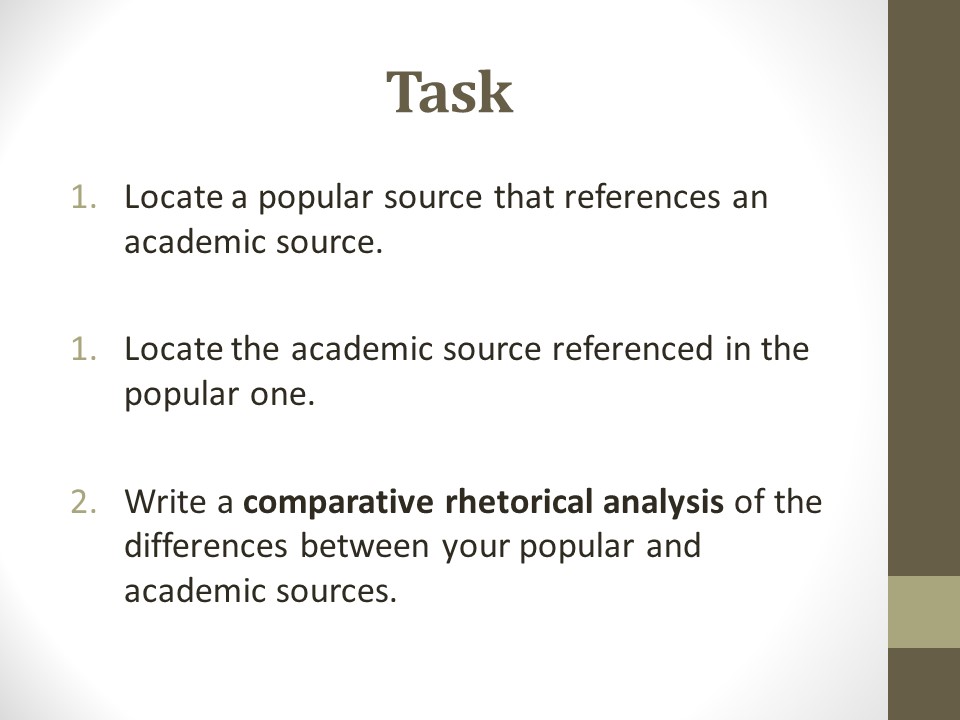
For a few years now, I've been using a version of an assignment developed by Dana Ferris in which the students perform a rhetorical analysis of two texts:
A study from a scholarly journal
The popular media's reporting on that issue.
It's worth noting here (as Dana pointed out in an FB comment,) this assignment was inspired by an assignment from the first edition of Writing about Writing by Elizabeth Wardle and Doug Downs.
I enjoy the assignment because it's big and messy and it gets at the larger learning objectives a first-year writing course should aim for.
And now I have a reason to show John Oliver in class!
I wrote as much on Facebook after sharing that video this morning (it's work-related).
One of my colleagues asked me to share the assignment, and so, here it is.
On the day I introduce the assignment, the students have two readings to complete before class.
One is an online textbook chapter on A) how much of a pain in the ass it is to read scholarly journal articles and B) some tips on how to read those articles.
In class we consider the readings (and in future classes, we'll watch that Last Week Tonight video), and then we walk through the assignment.
We then visit the library to A) meet with a librarian who shows us how to search for scholarly articles and B) search for a popular report on a subject that interests each student personally (maybe the topic is related to the student's major).
The goal is to give the students language they can use in their essays, and that's a lot of what lecture is about before introducing an in-class activity that asks students to complete a table by comparing rhetorical features of the two articles.
Then they draft, get peer feedback, revise, get instructor feedback, and finally have the option to revise for their portfolios.
Again, it's a great assignment, and now with more comedy!