Pages

Wednesday, September 18, 2013

Conservative TEXT Conventions!!!!!! ! ! !

I'll admit it. I like my Facebook. It is a safe little digital playground, a guilty pleasure more often than not. 

But occasionally Facebook provides an opportunity to dive down the rabbit hole of rhetoric. 

This exchange of comments shows how the use of ALL CAPS can demonstrate one of the more philosophical concepts that makes rhetoric such a fun area to study.
I don't see ALL CAPS abused in my classrooms very often. While there were a few years when students tried to use them in early drafts, that has all but disappeared. 

I do occasionally receive conservative chain emails from relatives, and that is a genre where ALL CAPS is alive and well. Those texts also incorporate changes to color, font, and font size to emphasize parts of the message. 

I have yet to spot a pattern or convention for what gets highlighted, bolded, or enlarged. It makes for some weird reading.
I've seen these conventions spill over into the explicitly conservative news/commentary outlets. The image here on the right is from the Breitbart website. 

The editor's choice to bold "Warned" and to make "Impotent" orange are examples of the spillover I'm taking about. 

The website doesn't bold all of the active verbs in headlines. Nor does the site change the color of text regularly. 

At first I assumed that the style changes indicated a hyperlink, but that's not the case. Here's the link that uses an orange impotent: DC's Gun Control Impotent. 
It's all one link. 

It's like the editors just got a new word processor and they're experimenting with the style features. But they're publishing those experiments. 

Some might be tempted to write this off as the errors of amateurs, but I think there's something else going on. 

This unique style is a signature of conservatives writing on the margins. It is a signal to readers: "If you are used to this style, you know you're in a safe place where your opinions will be validated." 

It's fascinating, and I think it developed like most writing conventions, without the conscious effort of the participants. 
For those who are curious, here's the video that started that Facebook exchange. It's great, and it helps explain why I have access to conservative email chains. 


Update (9/19/2013): A friend of mine brought this article from The Economist to my attention. In it, the author quotes the comment of a person who is upset Starbucks has requested that people do not bring guns into the chain's stores.
As one commenter on the Blaze writes, "It is my God Endowed Unalienable Individual Right, secured by Our Constitution, to take any firearm I please anywhere I please. Shall not be infringed, means exactly what it says."
The friend who sent me this was wondering about the use of capitalization, and if that fits into what I'm trying to describe here. My feeling is that it absolutely does, and what's more exciting is that a mainstream outlet like The Economist decided to preserve the style of the comment even though that style violates the style of their magazine.  

Sunday, September 15, 2013

The Fall of Lehman Brothers, How We Argue, and the Study of Composition and Rhetoric

Five years ago tomorrow, I wrote up my reaction to Lehman Brothers filling for bankruptcy.

I had (have) relatively little knowledge of how the finance industry functions, but I still managed to not sound like a complete idiot:
...[The collapse is] not like any of the world events we've experienced in my lifetime.
It doesn't have the feel of an attack or a war. It's not like a government falling. I'm tempted to link it to a natural disaster, but I'm afraid that's disrespectful because tsunamis and earthquakes take lives. I just can't place where this sits in my understanding of current events. 
That natural disaster analogy held up pretty well, if I do say so myself.

Of course, I hope no one took any of my predictions too seriously:
I'm not invested in much of anything beyond my apartment [in Budapest]. So the fall of Lehman Bros. is not going to reach into my pocket much. 
Yeah... That apartment I mentioned... Let's just say, its value was impacted a bit by the global financial meltdown.

In fact, later that year, I wrote about how my apartment-as-investment was impacted. I described my experience as a real estate owner in a struggling EU economy in a response to a National Review piece by Mark Steyn. That post led to some of the most spirited debate I've seen on this little blog (note to self: if you're looking to bring in readers, poke the hornets' nest).

The commenters that were sent my way by The National Review made some good points (after taking a few cheap shots at my degree in creative writing - which I thought was cute) . It was exciting to be involved in a debate of real substance with people who really disagree with me. And it's worth noting that (aside from one person) the debate was respectful - people thoughtfully disagreeing with an argument's premises or finding faults in logic.

The exchange flew in the face of stereotypes I held about political debate on the blogosphere. There was even one commenter who, before laying into my arguments, praised my decision to cite an article by an ideological opponent.

I don't think we solved any issues or even changed each others' minds very much. But I was impressed by the willingness to engage and listen (to anything under 2000 words, @directormovies). That defied my expectations and helped shift the focus of this blog towards public discourse and debate. I started asking questions about how the different styles of writing and rhetoric influence the way I react to arguments.

That shift impacted my teaching and started me down this path I'm on today. This fall I start collecting data for a dissertation that explores the learning environments of novice writers in a new community.

The kind of writing and thinking that went into that debate five years ago - it happens because people are engaged with a topic and a community. Their writing processes take cues from all over the place. People writing in that kind of dynamic environment learn from every interaction and from all the prep and scheming that goes into each interaction.

It's an exciting "place" to study.

My family may have taken a financial hit in the aftermath of the fall of Lehman Brothers, but we're hardly alone in that. Five years on, however, I can see how my reaction to those events led me in a positive direction. As an individual, I examined what had happened and sought out lessons and a new path.

So, that's me five years after. Where are you at?

Thursday, September 12, 2013

Reading for Pleasure and Learning

So, a longitudinal study out of the University of London's Institute of Education shows that children who read for pleasure do better in school.

It sounds obvious, right?

But the news is the range of benefits. Students' math scores improved alongside their reading and spelling scores. (Should I say maths scores if it's a UK study?)

And what's more, the study's design controlled for socioeconomic backgrounds. And then there's this: "Perhaps surprisingly, reading for pleasure was found to be more important for children’s cognitive development between ages 10 and 16 than their parents’ level of education."

I'm a big believer in the not-very-radical belief that school is only one part of a young person's learning environment, and it's always nice to have data to backs that up.

It's also nice to think that my love of pulpy fantasy novels and non-fiction accounts of the paranormal might have helped me in school.

Friday, September 06, 2013

Thrun's Take on Teaching and Technology

Sebastian Thrun speaks up/out on innovation in education in The Guardian.

"The biggest principle is to go at your own speed – eliminate this very strong synchronicity. It is the main obstacle for technology, to overcome the belief that a teacher and group of students have to go through the same thing at the same time," he said. "Education should learn from the positive side of gaming – reward, accomplishment and fun. An online environment would be able to use data about students' performance to more scientifically assess their progress, and how successfully a certain course is engaging students."

I like his take on the interaction between teachers and technology.

In writing education especially, the arguments always seem to pit teachers against technology. That's likely going to hold us back as a profession.

Thrun's critique of current testing models goes a long way towards explaining the reasons for the adversarial relationship between writing teachers and technology.

But if we take control of the tools (rather than passively hand control over to testing incorporated), I believe our discipline could move forward fast.

Friday, August 30, 2013

Seamus Heaney's Passing

I didn't know poetry very well before I read Heaney.

I didn't understand its challenge or its role. Then some poets in California introduced me to Heaney.

Since then I've found The Stolen Child, At the Fishhouses, and The Red Wheelbarrow... to name a few.

He changed the way many listen to words.


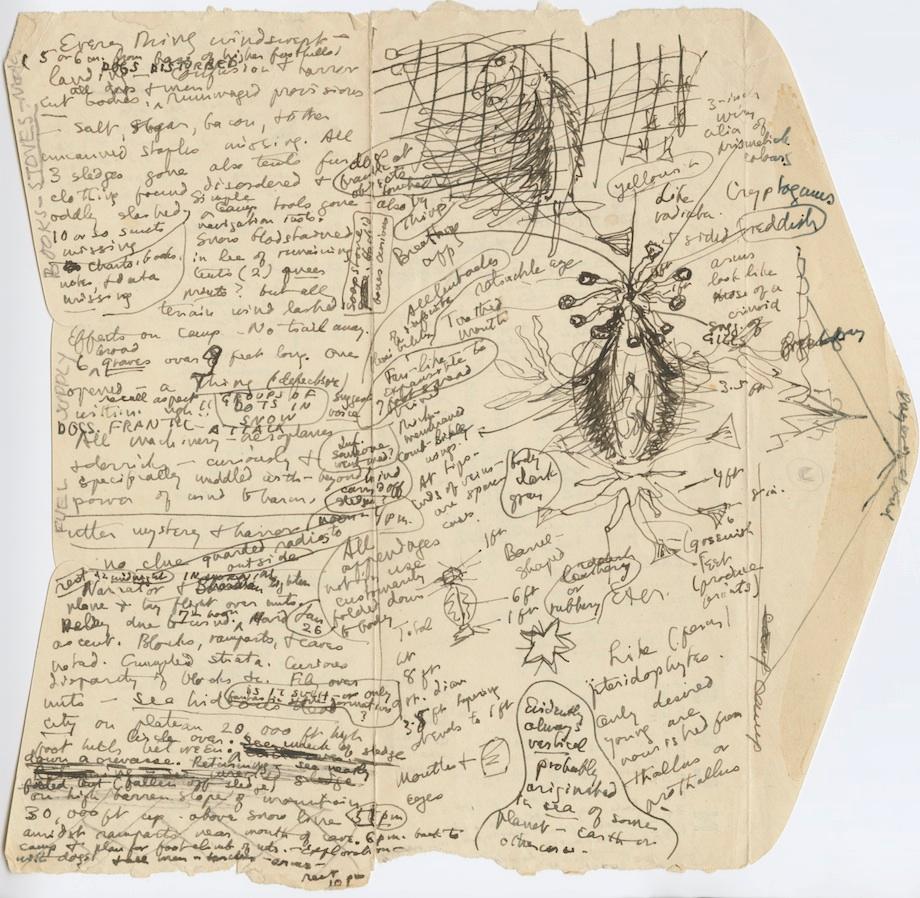
Lovecraftian Pre-writing

A "page" from Lovecraft's notes on At the Mountains of Madness was posted on Slate's Vault yesterday.

A lovely - if not slightly disturbing - reminder of how much chaos goes into pre-writing.
 Fun stuff.

Wednesday, August 28, 2013


Assessing the Professors

This TechCrunch article has its flaws, but it prompts an interesting question: 

If we were able to devise an assessment of the quality of a university professor's teaching, what would that assessment look like?

I know we'd mess it up if we designed the measures in today's political atmosphere - one that stresses a very limited version of job-readiness. 

But what if we scholars were able to devise their own assessment system for how well we teach?

Side note:
I followed the link to this TechCrunch article, because its title suggests the existence of a labor union for professors.

That seemed unlikely.

Turns out that the author mislabeled the American Association of University Professors, which is a professional association. There is a union component called the AAUP-CBC, but that is not the group that issued the statement on performance based funding.