Pages

Friday, January 25, 2013

Hypocrisy in Blue


Sheriff David Clarke of Milwaukee has gotten people even more fired up on the issue of gun regulations with his recent post on the Tea Party Perspective. He opens his piece with these sentences: "Shame on liberals for exploiting tragedy once again in our country and try (sic) to use tragedy as a reason to take our rights away.  Liberals are shameful."

Then, two paragraphs later, he writes, "All of these suggestions about the need for gun control are the mindset of sheep.  Once the wolf is at the door, you’re helpless.  Sure, run and hide from a sociopathic killer.  See how far that gets you.  You know where that ‘ll get you?  26 dead at Sandy Hook School."

I'm all for public figures speaking their minds on issues like this. The Sheriff is in a unique position of authority on the subject, and his voice ought to be heard.

That said, I didn't even have to use the scroll bar to find the most blatant example of hypocrisy in Sheriff Clarke's post.

He writes "shame on liberals" for using a tragedy to further their cause, and then he turns around and uses that same tragedy as evidence that we should further his cause.

Rarely do I see such a horrible abuse of rhetoric in public discourse. This is one for the books.

If you agree with the Sheriff, I suggest you volunteer to proofread his next rant.

If you disagree with the man, talk slowly as you explain the concept of hypocrisy to him and those who have rallied behind his post.

Monday, January 21, 2013

My New Five Disk Playlist

Once upon a time, I listened to music using compact disks.

I know, right?

When I wanted new music, I would head out to the record store and sort through racks and racks of CDs in jewel cases, sealed shut with that sticky security tape, then wrapped in plastic and clamped into plastic theft-prevention/display racks. It was like the dark ages.

But I loved my CDs. The collection was growing at its fastest rate during those years in which I was sorting out my identity. The collection was one of the first things I composed that said something about who I was.

As an undergrad, my favorite time of day to listen to my CDs was as I cooked and ate dinner.

I had a five-disk carousel CD player.  I would load it up and hit "Shuffle All."

I had friends who bemoaned "the end of the album," who worried that shuffle mode and playback programming meant there'd never be another

or

But I couldn't keep myself from enjoying the five-disk shuffle option my stereo afforded me. I got to pick five favorites. Each new song was a pleasant half-expected surprise. And oh, the suspense at the end of each song as I listened to the spent disk drop, the carousel turn, and the next disk spin into action. 

More recently, I've been uploading all my digitized music to a cloud service.

When the whole library finally loaded today, as a celebratory gesture, I created a '5 Disk Playlist.' Just like the old days, I dropped all the tracks of five albums into the list and hit shuffle. I'm listening to the playlist now. I have to wear headphones because my wife and son are sleeping, but other than that, it's a very 1996 listening experience. 
Except, I can listen to the list anywhere I go. And I can make another list for every month until I'm 50 years old, and I'll be able to listen to every one of those lists anywhere I can access the internet. Beyond that, I can allow an online service to read the contents of my collection and generate a playlist that combines my music with music suggested by what my collection says about me. 
I don't think this kind of change is bad. In fact, I love this kind of change, but I do miss mix tapes, album art, lining up at midnight to buy a new release, the clunks and clicks of record players. There is nothing wrong with technology changing the way we listen, but I would like to go on record saying this: There is also nothing wrong with being reluctant to let go of the quirks that a fading technology  imparted on our experience.
I'm working on a paper and a presentation about introducing electronic portfolio software in writing classrooms. E-portfolios have been around for a while, and people a lot smarter than me have demonstrated how effective they are as a learning tool. But it is still difficult to get programs and teachers to adopt the technology. 

The project I worked on at school went smoothly. Last quarter nearly 500 students composed electronic portfolios using open source software and online sharing tools. I'm thrilled with the results. Students developed their digital literacy. The reflective portions were displayed in a more authentic reading space than a series of 8" x 10.5" sheets of paper. Teachers delivered the tools to students effectively. Good stuff, sure, but I'm not going to pretend it was easy. There was a ton of trouble shooting. There was a fair amount of resistance from teachers and students alike. The days leading up to the end of the quarter were brutal.
When I took on the e-portfolio project, I hadn't yet considered the long and tortured route of music recording technology as an analogous cultural process. All the lost conventions, anachronistic jargon, obsolete equipment, and the bitter late adopters - it's all familiar. 

Tonight I gained access to my music through a new and exciting technology, and what did I do? I tried to recreate the listening experience shaped by the specifications of a stereo component from the mid-1990's.


Thursday, November 29, 2012

Teaching with E-portfolios

Here are the pages I worked up in Mahara for today's UWP teaching with technology roundtable.

You can also find the link on Twitter if you search #UWPTwT
Hope things go well.

Monday, November 05, 2012

Why Teach the Argument?


If politicians can gain by misrepresenting the facts, if people in finance can make millions by omitting key facts about investment opportunities, if manufacturers can dominate a market by hiding forced labor conditions, if these and other examples of evidence abused are true, then why should I focus so closely on the ethical use of evidence in a writing class?

In my writing course this quarter, we are finishing up the unit on argument and evidence. Everyone in the class picked an Oxford style debate to listen to. Now they are writing up a position paper intended to inform a continued user-generated online debate. We discussed the form and function of formal modes of debate. We also read about the etiquette and ethics of argumentation.

So on the eve of an election, I asked them if the rules of argument we've discussed in class are used to guide arguments in high profile settings like presidential campaigns.

I wasn't surprised to hear an overwhelming 'no,' but I was more interested in the answers to the next question: If we don't see quality arguments in high profile settings, then what is the advantage to learning how to produce a quality argument?

My students gave some thoughtful responses, but I'd like to throw this question out there.

With legislators suggesting that critical thinking is not a skill worth teaching in public schools, I think it would be worth it to hear a strong defense of defensible arguments.

So, why should we teach argument?

Wednesday, October 10, 2012

Shaken

For reasons I'd prefer to keep private, I spent the last month disengaged from political discourse. My mental and emotional faculties were needed elsewhere, and I'm pleased I was able to step back from what has always been an addictive interest in political debate.

I do love a good argument. I also love a bad argument. When it comes to politics, there are few things I enjoy more than popping the hood and getting a good look at what makes an argument run.

That's why I jump into discussions with people I disagree with. I think it's important. I'm convinced healthy democracy will wither when we stop listening to the other side.

But I have limits.

Today, two people who I have occasionally engaged in political argument prompted me to doubt my faith in the utility of discourse.

The first person posted an link to a Washington Times piece about a book on tax policy. The book might be interesting, but that is not what got my attention. Citing the Heritage Foundation, the WT author presented the following evidence to argue that lower tax rates on the wealthy are good for the American economy:

1920s: The top tax rate fell from 73 percent to 25 percent, yet the rich (in those days, those earning $50,000 and up) went from paying 44.2 percent of the tax burden in 1921 to paying more than 78 percent in 1928. 

You read that right. The author used the wealth-friendly tax policy from the 1920s to argue for more wealth-friendly tax policy.

How can I argue with a person who cannot see how stupid that is?

I can't.

The second person who shook my faith in the utility of argument was a Facebooker responding to a question about the new job numbers. The lead off to his argument was "Govt jobs should not count."

On a better day, I might have been able to stomach this, maybe even construct the reasoning that informs such a statement. But then I think about people serving in the military, fire fighters, food inspectors, judges, teachers, transportation safety officials, EMTs, sanitation workers, civic janitorial staff... I could keep going. But with each item on the list, I hear those words echo: " Govt jobs should not count."

How can I argue with someone who would posit that teaching or protecting a community shouldn't be counted as employment?

I can anticipate the response, but no matter how eloquently stated, no response could walk that back.

I can't imagine a way to reasonably converse with a person who would make that statement.

I'm at a bit of a loss. I would like to listen to people who hold political beliefs that are different than my own, but I've become convinced that those people aren't even listening to themselves anymore.


Friday, September 14, 2012

He Hasn't Seen the Study?

Both Mitt Romney and liberal media outlets are insulting the intelligence of the American public.

There is a real debate to be had about the Romney tax plan, but the debate is being overshadowed by inanities.

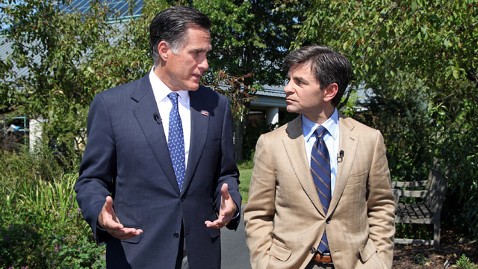
In his interview with George Stephanopoulos, Romney was pushed to offer some specifics on his tax plan.


Stephanopoulos acknowledged the studies that Romney has used to argue his plan will increase tax revenue. These are the studies Romney has used to answer critics who say his plan has arithmetic problems.

Stephanopoulos then asked about an important detail from one of those studies. He asked if Romney planned to "eliminate the home mortgage, charity, and state and local tax deductions for everyone earning over $100,000." This was one of the ways the Martin Feldstein study showed a rise in tax revenues.

Romney said he did not plan to eliminate those deductions. Stephanopoulos replied by saying those deductions are an essential part of Feldstein's plan.

To answer these concerns, Romney actually said these words: "Well, [Feldstein's study] doesn’t necessarily show the same growth that we’re anticipating.  And I haven’t seen his precise study."

Wait... what?

Take a moment to think about what Mitt Romney just said to George Stephanopoulos.

The study Romney has been citing as evidence doesn't show the same results he argues will materialize AND he hasn't seen the actual study.

When I read an argument based on ill-fitted evidence that the author hasn't actually read, I conclude that the argument is garbage. I challenge that author to provide a better case or change conclusions.

That is the detail voters need to investigate. That is the question that has been left unanswered.

But instead, liberal media outlets have decided to focus on comments Romney made a moment later about the middle income being $200,000/year. The general tenor of these articles has been, "Can you believe how out of touch this rich guy is?"

Stupid. Stupid. Stupid.


Mitt Romney and the media think this is too complex a thread to follow. Romney is hoping he can just let it all slip by, and the media think we'll pay more attention to character attacks.

I want to know where the money that will fund Romney's tax cut will come from. For the time being, I have to reject his plan as garbage because that is exactly what his argument supporting it is.

Sunday, August 26, 2012

Do you use the skills developed in your writing classes?


An early attempt at mapping writing skill transfer (spelling errors are included to test readers like you)

The picture above is what I worked on yesterday. I was attempting to clear up some concepts.

Here's what I'm going for in the picture:
I drew a timeline representing the writing development of an imaginary student named Pat. There's a hexagon to represent a task Pat composed in her freshman-year writing course. And there's a square representing a writing task she composed years later for an upper-division course in her major. These two events are described as separate, but they are really fragments of Pat's literacy development.

Here's the issue I'm attempting to get at: The type of writing Pat did in her freshman writing course is very different than the writing she did later in college - and later in life. This raises the following question: What skills did Pat learn in her freshman writing course that helped her with her later coursework?

The answer to that question should describe the skills teachers emphasize in freshman composition, but the work I've done for the past few years has shown that instructors often dodge this question or answer with vague unmeasurable abstractions.

The diagram is an attempt to get at something instructors can act on. It's still rough, but it is moving me in the right direction - away from the abstract.

Let's say that after Pat finished her freshman year she declared a major in mechanical engineering. Later, near the end of her junior year, Pat is told to write a technical report about some work she's done on wireless networking.

Take a moment to think about all the differences between between the two tasks
  • Time has past
  • The audience is different
  • The purpose for writing is different
  • The writing conventions are different
  • The subject matter is different
  • Pat is different!
It's easy to spot the differences. The challenge is to identify what remains constant.

The sidewalk in the video here changes over time, gains a new audience, and a new purpose. The chalk drawing fools the eye into thinking that the sidewalk is no longer a sidewalk at all. For someone hoping to create something like this, however, it is crucial to remain aware of the qualities the sidewalk had before the first line was drawn.

Getting back to Pat, which skills used to write her freshman composition paper are still useful when writing the technical report?

Here's the direction my drawing has taken me: Beyond a firm command of grammar and spelling, we expect a college-level writer to have skills that facilitate independent learning in new writing environments.

In other words, after completing college, Pat should have the skills required to join a new community and teach herself how to effectively write in that setting. Of course she can't do that alone. In order to learn to communicate in a new setting, the new community must afford Pat the time and resources required to learn about the ways people in that community write.

So, Pat has to know how to find and evaluate the writing of others. She has to know how to solicit, recognize, and utilize feedback. She must be practiced at self-assessment. She must know how to identify clues that will help her adjust her writing practices, which assumes she knows how to adjust her writing practices. And Pat needs to have the self-confidence and patience to recognize that these skills will only get her foot in the door - that writing for a new community will require the application of these skills to produce new knowledge - knowledge that will eventually help her gain a voice and authority in the communities she seeks to join.

I also believe that Pat should be intellectually wary of any community that makes it either too easy or too difficult for new members to move through these processes. But that's for another blog post.

So that's what I'm working on. I may take the blog along this road for a while. Trying to express these ideas for people who are not compositionists seems like a good way to maintain the blog while staying focused on my work.

Wednesday, August 22, 2012

Why Has the GOP Stopped Believing?

These guys still believe, but...

The GOP no longer believes in America's greatness.

Let me explain how I've reached this conclusion.

According to the plan they've put forth and defended, Romney and Ryan do not believe the American economy is strong or dynamic enough for our government to provide my generation and future generations with the services it has provided for the Baby Boomers and the Greatest Generation.

Specifically, the GOP believes the government cannot provide future generations with retirement income, healthcare for the retired, or assistance for the poorest among us. They seek to cut funding to the programs that support those services and allow the Baby Boomers to use up what funding is left.

So, according to the GOP, my generation should expect these programs to have shrunk or disappeared by the time they would be of any use to us.

Now, before we get into whether or not the programs are sustainable, let's look at the history of the America that had those programs in place.

Social Security, Medicare, and Medicaid are benefits that progressives put in place between the 1930s and the 1960s. My grandparents and my parents spent their adult lives with those benefits as part of the American economic landscape. I know conservatives hate those programs, but look at all our nation achieved with those programs in place. With Moon landings, the end of the Cold War, and the networking of the globe at the top of the list, it is difficult to paint those decades as anything but prosperous.While those programs were in place (although not necessarily because of them), our nation's wealth, strength, and importance have grown tremendously.

Romney and Ryan's plan, however, suggests that our American success story is over; the country is no longer successful enough to provide the same services that were in place for previous generations. Romney and Ryan are effectively saying that America's economy cannot support the country the same way it has during the past 50 years of growth, strength, and prosperity.

I find their assertion dubious, mostly because in the time since my generation has entered the workforce, the US economy has continued to grow (on average). In that time, America has faced several challenges. We have impeached a president, been attacked by terrorists, gone to war, and weathered a major recession. Nevertheless, we have continued to grow and prosper - even while the global economy is still struggling to recover from a massive balance sheet recession (one that inflated the value of both assets and low-skill labor).

Despite the dreary picture the GOP would have us believe, the US is recovering faster than the rest of the developed world. While the EU attempted austerity, we stepped in with stimulus. We believed our economy was strong enough to risk that debt. Today, the EU faces inflation, rising borrowing costs, and no job growth. We, on the other hand, have dodged inflation, our borrowing costs have remained low, and we have slow job growth. (UK economists are starting to see it our way, btw.) Ours is clearly a dynamic economy that can weather very rough times. In relation to the rest of the world, our nation is a strong as ever.

So, I don't accept Romney and Ryan's assertion that America is in decline. I believe America will continue to be great for generations. I'm sorry to see that the GOP has stopped believing in American greatness, but that is what their platform says.

Now they'll argue that their cuts to services will give more American room to grow. They'll argue that these programs are a drain on our national economy. They'll see my argument as a demand for another handout and assert that hardworking Americans don't need these programs.

To which I say:
Many among us may not have needed a safety net these past few decades, but what of the wage earners who were dreaming of starting a small business? What would have come to pass if Baby Boomers were uncertain about how they would pay for healthcare after they retired; if they were afraid to invest their nest eggs in that restaurant, that storefront, that software company, or that photography business? How many potential entrepreneurs would have balked if that net weren't in place? How many failed entrepreneurs would have been forced to become dependents in their children's' homes? Those costs would add up to very real economic losses for the nation.

But we don't have to worry about that. The programs were in place, and America has done wonderfully. My parents' generation is the most successful American generation in history. These programs do not limit entrepreneurs, small business owners, or visionaries. Historically, these programs have been the security people needed to take the first step toward greatness.


So, I assert that Romney and Ryan's lack of faith in our economic strength is either a belief that America's best days are behind us, a scare tactic, or the next attempt to cut proven programs they are philosophically opposed to (probably a combination of the three). Whatever the case, I am not buying the defeatism that the GOP is pushing.