For reasons I'd prefer to keep private, I spent the last month disengaged from political discourse. My mental and emotional faculties were needed elsewhere, and I'm pleased I was able to step back from what has always been an addictive interest in political debate.
I do love a good argument. I also love a bad argument. When it comes to politics, there are few things I enjoy more than popping the hood and getting a good look at what makes an argument run.
That's why I jump into discussions with people I disagree with. I think it's important. I'm convinced healthy democracy will wither when we stop listening to the other side.
But I have limits.
Today, two people who I have occasionally engaged in political argument prompted me to doubt my faith in the utility of discourse.
The first person posted an link to a Washington Times piece about a book on tax policy. The book might be interesting, but that is not what got my attention. Citing the Heritage Foundation, the WT author presented the following evidence to argue that lower tax rates on the wealthy are good for the American economy:
1920s: The top tax rate fell from 73 percent to 25
percent, yet the rich (in those days, those earning $50,000 and up) went
from paying 44.2 percent of the tax burden in 1921 to paying more than
78 percent in 1928.
You read that right. The author used the wealth-friendly tax policy from the 1920s to argue for more wealth-friendly tax policy.
How can I argue with a person who cannot see how stupid that is?
I can't.
The second person who shook my faith in the utility of argument was a Facebooker responding to a question about the new job numbers. The lead off to his argument was "Govt jobs should not count."
On a better day, I might have been able to stomach this, maybe even construct the reasoning that informs such a statement. But then I think about people serving in the military, fire fighters, food inspectors, judges, teachers, transportation safety officials, EMTs, sanitation workers, civic janitorial staff... I could keep going. But with each item on the list, I hear those words echo: " Govt jobs should not count."
How can I argue with someone who would posit that teaching or protecting a community shouldn't be counted as employment?
I can anticipate the response, but no matter how eloquently stated, no response could walk that back.
I can't imagine a way to reasonably converse with a person who would make that statement.
I'm at a bit of a loss. I would like to listen to people who hold political beliefs that are different than my own, but I've become convinced that those people aren't even listening to themselves anymore.
Examining writing, arguments, communication, education, teaching, and ways of engaging with others.
Wednesday, October 10, 2012
Friday, September 14, 2012
He Hasn't Seen the Study?
Both Mitt Romney and liberal media outlets are insulting the intelligence of the American public.
There is a real debate to be had about the Romney tax plan, but the debate is being overshadowed by inanities.
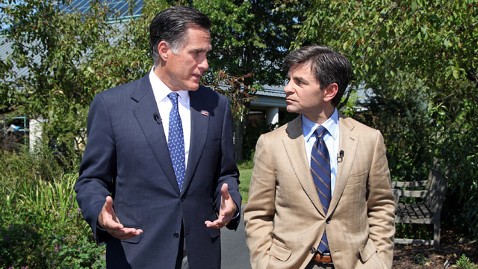
In his interview with George Stephanopoulos, Romney was pushed to offer some specifics on his tax plan.
Stephanopoulos acknowledged the studies that Romney has used to argue his plan will increase tax revenue. These are the studies Romney has used to answer critics who say his plan has arithmetic problems.
Stephanopoulos then asked about an important detail from one of those studies. He asked if Romney planned to "eliminate the home mortgage, charity, and state and local tax deductions for everyone earning over $100,000." This was one of the ways the Martin Feldstein study showed a rise in tax revenues.
Romney said he did not plan to eliminate those deductions. Stephanopoulos replied by saying those deductions are an essential part of Feldstein's plan.
To answer these concerns, Romney actually said these words: "Well, [Feldstein's study] doesn’t necessarily show the same growth that we’re anticipating. And I haven’t seen his precise study."
Wait... what?
Take a moment to think about what Mitt Romney just said to George Stephanopoulos.
The study Romney has been citing as evidence doesn't show the same results he argues will materialize AND he hasn't seen the actual study.
When I read an argument based on ill-fitted evidence that the author hasn't actually read, I conclude that the argument is garbage. I challenge that author to provide a better case or change conclusions.
That is the detail voters need to investigate. That is the question that has been left unanswered.
But instead, liberal media outlets have decided to focus on comments Romney made a moment later about the middle income being $200,000/year. The general tenor of these articles has been, "Can you believe how out of touch this rich guy is?"
Stupid. Stupid. Stupid.
Mitt Romney and the media think this is too complex a thread to follow. Romney is hoping he can just let it all slip by, and the media think we'll pay more attention to character attacks.
I want to know where the money that will fund Romney's tax cut will come from. For the time being, I have to reject his plan as garbage because that is exactly what his argument supporting it is.
There is a real debate to be had about the Romney tax plan, but the debate is being overshadowed by inanities.
In his interview with George Stephanopoulos, Romney was pushed to offer some specifics on his tax plan.
Stephanopoulos acknowledged the studies that Romney has used to argue his plan will increase tax revenue. These are the studies Romney has used to answer critics who say his plan has arithmetic problems.
Stephanopoulos then asked about an important detail from one of those studies. He asked if Romney planned to "eliminate the home mortgage, charity, and state and local tax deductions for everyone earning over $100,000." This was one of the ways the Martin Feldstein study showed a rise in tax revenues.
Romney said he did not plan to eliminate those deductions. Stephanopoulos replied by saying those deductions are an essential part of Feldstein's plan.
To answer these concerns, Romney actually said these words: "Well, [Feldstein's study] doesn’t necessarily show the same growth that we’re anticipating. And I haven’t seen his precise study."
Wait... what?
Take a moment to think about what Mitt Romney just said to George Stephanopoulos.
The study Romney has been citing as evidence doesn't show the same results he argues will materialize AND he hasn't seen the actual study.
When I read an argument based on ill-fitted evidence that the author hasn't actually read, I conclude that the argument is garbage. I challenge that author to provide a better case or change conclusions.
That is the detail voters need to investigate. That is the question that has been left unanswered.
But instead, liberal media outlets have decided to focus on comments Romney made a moment later about the middle income being $200,000/year. The general tenor of these articles has been, "Can you believe how out of touch this rich guy is?"
Stupid. Stupid. Stupid.
Mitt Romney and the media think this is too complex a thread to follow. Romney is hoping he can just let it all slip by, and the media think we'll pay more attention to character attacks.
I want to know where the money that will fund Romney's tax cut will come from. For the time being, I have to reject his plan as garbage because that is exactly what his argument supporting it is.
Sunday, August 26, 2012
Do you use the skills developed in your writing classes?
![]() | |
| An early attempt at mapping writing skill transfer (spelling errors are included to test readers like you) |
The picture above is what I worked on yesterday. I was attempting to clear up some concepts.
Here's what I'm going for in the picture:
I drew a timeline representing the writing development of an imaginary student named Pat. There's a hexagon to represent a task Pat composed in her freshman-year writing course. And there's a square representing a writing task she composed years later for an upper-division course in her major. These two events are described as separate, but they are really fragments of Pat's literacy development.
Here's the issue I'm attempting to get at: The type of writing Pat did in her freshman writing course is very different than the writing she did later in college - and later in life. This raises the following question: What skills did Pat learn in her freshman writing course that helped her with her later coursework?
The answer to that question should describe the skills teachers emphasize in freshman composition, but the work I've done for the past few years has shown that instructors often dodge this question or answer with vague unmeasurable abstractions.
The diagram is an attempt to get at something instructors can act on. It's still rough, but it is moving me in the right direction - away from the abstract.
Let's say that after Pat finished her freshman year she declared a major in mechanical engineering. Later, near the end of her junior year, Pat is told to write a technical report about some work she's done on wireless networking.
Take a moment to think about all the differences between between the two tasks
- Time has past
- The audience is different
- The purpose for writing is different
- The writing conventions are different
- The subject matter is different
- Pat is different!
The sidewalk in the video here changes over time, gains a new audience, and a new purpose. The chalk drawing fools the eye into thinking that the sidewalk is no longer a sidewalk at all. For someone hoping to create something like this, however, it is crucial to remain aware of the qualities the sidewalk had before the first line was drawn.
Getting back to Pat, which skills used to write her freshman composition paper are still useful when writing the technical report?
Here's the direction my drawing has taken me: Beyond a firm command of grammar and spelling, we expect a college-level writer to have skills that facilitate independent learning in new writing environments.
In other words, after completing college, Pat should have the skills required to join a new community and teach herself how to effectively write in that setting. Of course she can't do that alone. In order to learn to communicate in a new setting, the new community must afford Pat the time and resources required to learn about the ways people in that community write.
So, Pat has to know how to find and evaluate the writing of others. She has to know how to solicit, recognize, and utilize feedback. She must be practiced at self-assessment. She must know how to identify clues that will help her adjust her writing practices, which assumes she knows how to adjust her writing practices. And Pat needs to have the self-confidence and patience to recognize that these skills will only get her foot in the door - that writing for a new community will require the application of these skills to produce new knowledge - knowledge that will eventually help her gain a voice and authority in the communities she seeks to join.
I also believe that Pat should be intellectually wary of any community that makes it either too easy or too difficult for new members to move through these processes. But that's for another blog post.
So that's what I'm working on. I may take the blog along this road for a while. Trying to express these ideas for people who are not compositionists seems like a good way to maintain the blog while staying focused on my work.
Wednesday, August 22, 2012
Why Has the GOP Stopped Believing?
| These guys still believe, but... |
The GOP no longer believes in America's greatness.
Let me explain how I've reached this conclusion.
According to the plan they've put forth and defended, Romney and Ryan do not believe the American economy is strong or dynamic enough for our government to provide my generation and future generations with the services it has provided for the Baby Boomers and the Greatest Generation.
Specifically, the GOP believes the government cannot provide future generations with retirement income, healthcare for the retired, or assistance for the poorest among us. They seek to cut funding to the programs that support those services and allow the Baby Boomers to use up what funding is left.
So, according to the GOP, my generation should expect these programs to have shrunk or disappeared by the time they would be of any use to us.
Now, before we get into whether or not the programs are sustainable, let's look at the history of the America that had those programs in place.
Social Security, Medicare, and Medicaid are benefits that progressives put in place between the 1930s and the 1960s. My grandparents and my parents spent their adult lives with those benefits as part of the American economic landscape. I know conservatives hate those programs, but look at all our nation achieved with those programs in place. With Moon landings, the end of the Cold War, and the networking of the globe at the top of the list, it is difficult to paint those decades as anything but prosperous.While those programs were in place (although not necessarily because of them), our nation's wealth, strength, and importance have grown tremendously.
Romney and Ryan's plan, however, suggests that our American success story is over; the country is no longer successful enough to provide the same services that were in place for previous generations. Romney and Ryan are effectively saying that America's economy cannot support the country the same way it has during the past 50 years of growth, strength, and prosperity.
Despite the dreary picture the GOP would have us believe, the US is recovering faster than the rest of the developed world. While the EU attempted austerity, we stepped in with stimulus. We believed our economy was strong enough to risk that debt. Today, the EU faces inflation, rising borrowing costs, and no job growth. We, on the other hand, have dodged inflation, our borrowing costs have remained low, and we have slow job growth. (UK economists are starting to see it our way, btw.) Ours is clearly a dynamic economy that can weather very rough times. In relation to the rest of the world, our nation is a strong as ever.
So, I don't accept Romney and Ryan's assertion that America is in decline. I believe America will continue to be great for generations. I'm sorry to see that the GOP has stopped believing in American greatness, but that is what their platform says.
Now they'll argue that their cuts to services will give more American room to grow. They'll argue that these programs are a drain on our national economy. They'll see my argument as a demand for another handout and assert that hardworking Americans don't need these programs.
To which I say:
Many among us may not have needed a safety net these past few decades, but what of the wage earners who were dreaming of starting a small business? What would have come to pass if Baby Boomers were uncertain about how they would pay for healthcare after they retired; if they were afraid to invest their nest eggs in that restaurant, that storefront, that software company, or that photography business? How many potential entrepreneurs would have balked if that net weren't in place? How many failed entrepreneurs would have been forced to become dependents in their children's' homes? Those costs would add up to very real economic losses for the nation.
But we don't have to worry about that. The programs were in place, and America has done wonderfully. My parents' generation is the most successful American generation in history. These programs do not limit entrepreneurs, small business owners, or visionaries. Historically, these programs have been the security people needed to take the first step toward greatness.
So, I assert that Romney and Ryan's lack of faith in our economic strength is either a belief that America's best days are behind us, a scare tactic, or the next attempt to cut proven programs they are philosophically opposed to (probably a combination of the three). Whatever the case, I am not buying the defeatism that the GOP is pushing.
Tuesday, February 28, 2012
Fair to the Truth
NPR's new handbook caught my attention today. I doubt I'm alone.
Boing Boing reported on this, linking to the Pressthink post, and these are the kinds of outlets that lead to wider coverage.
Most of the new handbook is pretty standard stuff, but the concept of "fair to the truth" is bound to get attention, and it's is worthy of any attention it gets - particularly in a world where ideas about the media, authority, context, and the value of information are all in flux.
From the handbook:
A few weeks ago, I wrote about how the age of digital information places the burden of context in the hands of the critical consumer. I see NPR's concept as a way of placing their services in the middle of that context-sorting process.
NPR is acknowledging that the information is all out there, and the older paradigm's attempts to report all points of view does not help consumers - the news has become a series of opinionated people telling us what to think about an event.
Instead, NPR would like to add a lens to their reporting that acknowledges how news maker's often seek to spin a story.
Critics will howl, as is their want. They'll view this as an attempt to allow editorial views into the news content - where it doesn't belong. But a critical consumer of news knows that there's always been an editorial view in our news content. The people who decide what news gets covered are making editorial decisions (btw, did you know we've been at war for the past 9 years?)
So now we have this new concept: fair to the truth. I'm interested to see if the concept gets traction outside of NPR.
I have long since grown tired of watching political bickering being portrayed as news. I hope this is a shift away from that.
I just hope it doesn't change the format of Wait, Wait...
Boing Boing reported on this, linking to the Pressthink post, and these are the kinds of outlets that lead to wider coverage.
Most of the new handbook is pretty standard stuff, but the concept of "fair to the truth" is bound to get attention, and it's is worthy of any attention it gets - particularly in a world where ideas about the media, authority, context, and the value of information are all in flux.
From the handbook:
...our primary consideration when presenting the news is that we are fair to the truth. If our sources try to mislead us or put a false spin on the information they give us, we tell our audience. If the balance of evidence in a matter of controversy weighs heavily on one side, we acknowledge it in our reports.
A few weeks ago, I wrote about how the age of digital information places the burden of context in the hands of the critical consumer. I see NPR's concept as a way of placing their services in the middle of that context-sorting process.
NPR is acknowledging that the information is all out there, and the older paradigm's attempts to report all points of view does not help consumers - the news has become a series of opinionated people telling us what to think about an event.
Instead, NPR would like to add a lens to their reporting that acknowledges how news maker's often seek to spin a story.
Critics will howl, as is their want. They'll view this as an attempt to allow editorial views into the news content - where it doesn't belong. But a critical consumer of news knows that there's always been an editorial view in our news content. The people who decide what news gets covered are making editorial decisions (btw, did you know we've been at war for the past 9 years?)
So now we have this new concept: fair to the truth. I'm interested to see if the concept gets traction outside of NPR.
I have long since grown tired of watching political bickering being portrayed as news. I hope this is a shift away from that.
I just hope it doesn't change the format of Wait, Wait...
Thursday, February 23, 2012
Reaction to "We, The Web Kids"
Below is some of the best writing about the internet and culture that I have ever read. It is Piotr Czerski's "We, the Web Kids."
It's been translated from the original Polish and posted on Pastebin. (Go Central European thinkers!)
I think this text should be required reading for anyone looking to talk about the role of the internet in society.
Best quote: "What unites us is not a common, limited cultural context, but the belief that the context is self-defined and an effect of free choice."
While I think the text is fantastic, I do have a thing or two to say about the way Czerski sets the Web Kids apart from older generations.
I am not a Web Kid. Czerski states that the Kids who grew up with the web did so over the past 15 years. I was 21 when that period began. Not a kid.
It is true that I didn't grow up with the web. Instead, the web grew up with me.
I remember going to my friend Ryan Raddatz's house and setting a phone receiver on a modem to dial into BBSs where we downloaded space-based strategy games and lists of other BBSs. That was probably in 1989 or 1990.
I remember the Gopher competing with the world wide web back when I was a freshman at Columbia College in Chicago (before I transferred to Madison). The computer geeks who lived down the hall showed me that there were in fact two internets to search.
By the time I was finishing college, the web started to look something like what it has become, but my generation watched it mature through a very difficult awkward stage.
I can't claim to have had much of an impact on its development, but I do think the relationship between my generation and the web is unique - and that relationship blurs the line Czerski uses to divide his generation from my own.
I did not grow up with the internet, but I bore witness as it changed us... and as we changed it.
The Web Kids have a different perspective than the generation that proceeded them, but my generation benefits from a different kind of knowledge. We know how much the Web can change. The last 15 years of web development have been amazing, but that is also true of the last 25 years.
For me, the Web isn't a part of who I am, it is more like a familiar companion with whom I grew up.
And there's a powerful bond between two who endure their awkward stages together.
Psst, hey, Internet. If you promise never to tell anyone that Poison was my first favorite band, I won't tell anyone that you used to think AOL was the coolest.
Oh, and btw, if you want to read a fun inter-generational battle on Czerski's piece, visit The Atlantic's posting of it and read the comments.
Piotr Czerski
We, the Web Kids.
(translated by Marta Szreder)
There is probably no other word that would be as overused in the media discourse as ‘generation’. I once tried to count the ‘generations’ that have been proclaimed in the past ten years, since the well-known article about the so-called ‘Generation Nothing’; I believe there were as many as twelve. They all had one thing in common: they only existed on paper. Reality never provided us with a single tangible, meaningful, unforgettable impulse, the common experience of which would forever distinguish us from the previous generations. We had been looking for it, but instead the groundbreaking change came unnoticed, along with cable TV, mobile phones, and, most of all, Internet access. It is only today that we can fully comprehend how much has changed during the past fifteen years.
We, the Web kids; we, who have grown up with the Internet and on the Internet, are a generation who meet the criteria for the term in a somewhat subversive way. We did not experience an impulse from reality, but rather a metamorphosis of the reality itself. What unites us is not a common, limited cultural context, but the belief that the context is self-defined and an effect of free choice.
Writing this, I am aware that I am abusing the pronoun ‘we’, as our ‘we’ is fluctuating, discontinuous, blurred, according to old categories: temporary. When I say ‘we’, it means ‘many of us’ or ‘some of us’. When I say ‘we are’, it means ‘we often are’. I say ‘we’ only so as to be able to talk about us at all.
1.
We grew up with the Internet and on the Internet. This is what makes us different; this is what makes the crucial, although surprising from your point of view, difference: we do not ‘surf’ and the internet to us is not a ‘place’ or ‘virtual space’. The Internet to us is not something external to reality but a part of it: an invisible yet constantly present layer intertwined with the physical environment. We do not use the Internet, we live on the Internet and along it. If we were to tell our bildnungsroman to you, the analog, we could say there was a natural Internet aspect to every single experience that has shaped us. We made friends and enemies online, we prepared cribs for tests online, we planned parties and studying sessions online, we fell in love and broke up online. The Web to us is not a technology which we had to learn and which we managed to get a grip of. The Web is a process, happening continuously and continuously transforming before our eyes; with us and through us. Technologies appear and then dissolve in the peripheries, websites are built, they bloom and then pass away, but the Web continues, because we are the Web; we, communicating with one another in a way that comes naturally to us, more intense and more efficient than ever before in the history of mankind.
Brought up on the Web we think differently. The ability to find information is to us something as basic, as the ability to find a railway station or a post office in an unknown city is to you. When we want to know something - the first symptoms of chickenpox, the reasons behind the sinking of ‘Estonia’, or whether the water bill is not suspiciously high - we take measures with the certainty of a driver in a SatNav-equipped car. We know that we are going to find the information we need in a lot of places, we know how to get to those places, we know how to assess their credibility. We have learned to accept that instead of one answer we find many different ones, and out of these we can abstract the most likely version, disregarding the ones which do not seem credible. We select, we filter, we remember, and we are ready to swap the learned information for a new, better one, when it comes along.
To us, the Web is a sort of shared external memory. We do not have to remember unnecessary details: dates, sums, formulas, clauses, street names, detailed definitions. It is enough for us to have an abstract, the essence that is needed to process the information and relate it to others. Should we need the details, we can look them up within seconds. Similarly, we do not have to be experts in everything, because we know where to find people who specialise in what we ourselves do not know, and whom we can trust. People who will share their expertise with us not for profit, but because of our shared belief that information exists in motion, that it wants to be free, that we all benefit from the exchange of information. Every day: studying, working, solving everyday issues, pursuing interests. We know how to compete and we like to do it, but our competition, our desire to be different, is built on knowledge, on the ability to interpret and process information, and not on monopolising it.
2.
Participating in cultural life is not something out of ordinary to us: global culture is the fundamental building block of our identity, more important for defining ourselves than traditions, historical narratives, social status, ancestry, or even the language that we use. From the ocean of cultural events we pick the ones that suit us the most; we interact with them, we review them, we save our reviews on websites created for that purpose, which also give us suggestions of other albums, films or games that we might like. Some films, series or videos we watch together with colleagues or with friends from around the world; our appreciation of some is only shared by a small group of people that perhaps we will never meet face to face. This is why we feel that culture is becoming simultaneously global and individual. This is why we need free access to it.
This does not mean that we demand that all products of culture be available to us without charge, although when we create something, we usually just give it back for circulation. We understand that, despite the increasing accessibility of technologies which make the quality of movie or sound files so far reserved for professionals available to everyone, creativity requires effort and investment. We are prepared to pay, but the giant commission that distributors ask for seems to us to be obviously overestimated. Why should we pay for the distribution of information that can be easily and perfectly copied without any loss of the original quality? If we are only getting the information alone, we want the price to be proportional to it. We are willing to pay more, but then we expect to receive some added value: an interesting packaging, a gadget, a higher quality, the option of watching here and now, without waiting for the file to download. We are capable of showing appreciation and we do want to reward the artist (since money stopped being paper notes and became a string of numbers on the screen, paying has become a somewhat symbolic act of exchange that is supposed to benefit both parties), but the sales goals of corporations are of no interest to us whatsoever. It is not our fault that their business has ceased to make sense in its traditional form, and that instead of accepting the challenge and trying to reach us with something more than we can get for free they have decided to defend their obsolete ways.
One more thing: we do not want to pay for our memories. The films that remind us of our childhood, the music that accompanied us ten years ago: in the external memory network these are simply memories. Remembering them, exchanging them, and developing them is to us something as natural as the memory of ‘Casablanca’ is to you. We find online the films that we watched as children and we show them to our children, just as you told us the story about the Little Red Riding Hood or Goldilocks. Can you imagine that someone could accuse you of breaking the law in this way? We cannot, either.
3.
We are used to our bills being paid automatically, as long as our account balance allows for it; we know that starting a bank account or changing the mobile network is just the question of filling in a single form online and signing an agreement delivered by a courier; that even a trip to the other side of Europe with a short sightseeing of another city on the way can be organised in two hours. Consequently, being the users of the state, we are increasingly annoyed by its archaic interface. We do not understand why tax act takes several forms to complete, the main of which has more than a hundred questions. We do not understand why we are required to formally confirm moving out of one permanent address to move in to another, as if councils could not communicate with each other without our intervention (not to mention that the necessity to have a permanent address is itself absurd enough.)
There is not a trace in us of that humble acceptance displayed by our parents, who were convinced that administrative issues were of utmost importance and who considered interaction with the state as something to be celebrated. We do not feel that respect, rooted in the distance between the lonely citizen and the majestic heights where the ruling class reside, barely visible through the clouds. Our view of the social structure is different from yours: society is a network, not a hierarchy. We are used to being able to start a dialogue with anyone, be it a professor or a pop star, and we do not need any special qualifications related to social status. The success of the interaction depends solely on whether the content of our message will be regarded as important and worthy of reply. And if, thanks to cooperation, continuous dispute, defending our arguments against critique, we have a feeling that our opinions on many matters are simply better, why would we not expect a serious dialogue with the government?
We do not feel a religious respect for ‘institutions of democracy’ in their current form, we do not believe in their axiomatic role, as do those who see ‘institutions of democracy’ as a monument for and by themselves. We do not need monuments. We need a system that will live up to our expectations, a system that is transparent and proficient. And we have learned that change is possible: that every uncomfortable system can be replaced and is replaced by a new one, one that is more efficient, better suited to our needs, giving more opportunities.
What we value the most is freedom: freedom of speech, freedom of access to information and to culture. We feel that it is thanks to freedom that the Web is what it is, and that it is our duty to protect that freedom. We owe that to next generations, just as much as we owe to protect the environment.
Perhaps we have not yet given it a name, perhaps we are not yet fully aware of it, but I guess what we want is real, genuine democracy. Democracy that, perhaps, is more than is dreamt of in your journalism.
___
"My, dzieci sieci" by Piotr Czerski is licensed under a Creative Commons Uznanie autorstwa-Na tych samych warunkach 3.0 Unported License:
http://creativecommons.org/licenses/by-sa/3.0/
Contact the author: piotr[at]czerski.art.pl
It's been translated from the original Polish and posted on Pastebin. (Go Central European thinkers!)
I think this text should be required reading for anyone looking to talk about the role of the internet in society.
Best quote: "What unites us is not a common, limited cultural context, but the belief that the context is self-defined and an effect of free choice."
While I think the text is fantastic, I do have a thing or two to say about the way Czerski sets the Web Kids apart from older generations.
I am not a Web Kid. Czerski states that the Kids who grew up with the web did so over the past 15 years. I was 21 when that period began. Not a kid.
It is true that I didn't grow up with the web. Instead, the web grew up with me.
I remember going to my friend Ryan Raddatz's house and setting a phone receiver on a modem to dial into BBSs where we downloaded space-based strategy games and lists of other BBSs. That was probably in 1989 or 1990.
I remember the Gopher competing with the world wide web back when I was a freshman at Columbia College in Chicago (before I transferred to Madison). The computer geeks who lived down the hall showed me that there were in fact two internets to search.
By the time I was finishing college, the web started to look something like what it has become, but my generation watched it mature through a very difficult awkward stage.
I can't claim to have had much of an impact on its development, but I do think the relationship between my generation and the web is unique - and that relationship blurs the line Czerski uses to divide his generation from my own.
I did not grow up with the internet, but I bore witness as it changed us... and as we changed it.
The Web Kids have a different perspective than the generation that proceeded them, but my generation benefits from a different kind of knowledge. We know how much the Web can change. The last 15 years of web development have been amazing, but that is also true of the last 25 years.
For me, the Web isn't a part of who I am, it is more like a familiar companion with whom I grew up.
And there's a powerful bond between two who endure their awkward stages together.
Psst, hey, Internet. If you promise never to tell anyone that Poison was my first favorite band, I won't tell anyone that you used to think AOL was the coolest.
Oh, and btw, if you want to read a fun inter-generational battle on Czerski's piece, visit The Atlantic's posting of it and read the comments.
Piotr Czerski
We, the Web Kids.
(translated by Marta Szreder)
There is probably no other word that would be as overused in the media discourse as ‘generation’. I once tried to count the ‘generations’ that have been proclaimed in the past ten years, since the well-known article about the so-called ‘Generation Nothing’; I believe there were as many as twelve. They all had one thing in common: they only existed on paper. Reality never provided us with a single tangible, meaningful, unforgettable impulse, the common experience of which would forever distinguish us from the previous generations. We had been looking for it, but instead the groundbreaking change came unnoticed, along with cable TV, mobile phones, and, most of all, Internet access. It is only today that we can fully comprehend how much has changed during the past fifteen years.
We, the Web kids; we, who have grown up with the Internet and on the Internet, are a generation who meet the criteria for the term in a somewhat subversive way. We did not experience an impulse from reality, but rather a metamorphosis of the reality itself. What unites us is not a common, limited cultural context, but the belief that the context is self-defined and an effect of free choice.
Writing this, I am aware that I am abusing the pronoun ‘we’, as our ‘we’ is fluctuating, discontinuous, blurred, according to old categories: temporary. When I say ‘we’, it means ‘many of us’ or ‘some of us’. When I say ‘we are’, it means ‘we often are’. I say ‘we’ only so as to be able to talk about us at all.
1.
We grew up with the Internet and on the Internet. This is what makes us different; this is what makes the crucial, although surprising from your point of view, difference: we do not ‘surf’ and the internet to us is not a ‘place’ or ‘virtual space’. The Internet to us is not something external to reality but a part of it: an invisible yet constantly present layer intertwined with the physical environment. We do not use the Internet, we live on the Internet and along it. If we were to tell our bildnungsroman to you, the analog, we could say there was a natural Internet aspect to every single experience that has shaped us. We made friends and enemies online, we prepared cribs for tests online, we planned parties and studying sessions online, we fell in love and broke up online. The Web to us is not a technology which we had to learn and which we managed to get a grip of. The Web is a process, happening continuously and continuously transforming before our eyes; with us and through us. Technologies appear and then dissolve in the peripheries, websites are built, they bloom and then pass away, but the Web continues, because we are the Web; we, communicating with one another in a way that comes naturally to us, more intense and more efficient than ever before in the history of mankind.
Brought up on the Web we think differently. The ability to find information is to us something as basic, as the ability to find a railway station or a post office in an unknown city is to you. When we want to know something - the first symptoms of chickenpox, the reasons behind the sinking of ‘Estonia’, or whether the water bill is not suspiciously high - we take measures with the certainty of a driver in a SatNav-equipped car. We know that we are going to find the information we need in a lot of places, we know how to get to those places, we know how to assess their credibility. We have learned to accept that instead of one answer we find many different ones, and out of these we can abstract the most likely version, disregarding the ones which do not seem credible. We select, we filter, we remember, and we are ready to swap the learned information for a new, better one, when it comes along.
To us, the Web is a sort of shared external memory. We do not have to remember unnecessary details: dates, sums, formulas, clauses, street names, detailed definitions. It is enough for us to have an abstract, the essence that is needed to process the information and relate it to others. Should we need the details, we can look them up within seconds. Similarly, we do not have to be experts in everything, because we know where to find people who specialise in what we ourselves do not know, and whom we can trust. People who will share their expertise with us not for profit, but because of our shared belief that information exists in motion, that it wants to be free, that we all benefit from the exchange of information. Every day: studying, working, solving everyday issues, pursuing interests. We know how to compete and we like to do it, but our competition, our desire to be different, is built on knowledge, on the ability to interpret and process information, and not on monopolising it.
2.
Participating in cultural life is not something out of ordinary to us: global culture is the fundamental building block of our identity, more important for defining ourselves than traditions, historical narratives, social status, ancestry, or even the language that we use. From the ocean of cultural events we pick the ones that suit us the most; we interact with them, we review them, we save our reviews on websites created for that purpose, which also give us suggestions of other albums, films or games that we might like. Some films, series or videos we watch together with colleagues or with friends from around the world; our appreciation of some is only shared by a small group of people that perhaps we will never meet face to face. This is why we feel that culture is becoming simultaneously global and individual. This is why we need free access to it.
This does not mean that we demand that all products of culture be available to us without charge, although when we create something, we usually just give it back for circulation. We understand that, despite the increasing accessibility of technologies which make the quality of movie or sound files so far reserved for professionals available to everyone, creativity requires effort and investment. We are prepared to pay, but the giant commission that distributors ask for seems to us to be obviously overestimated. Why should we pay for the distribution of information that can be easily and perfectly copied without any loss of the original quality? If we are only getting the information alone, we want the price to be proportional to it. We are willing to pay more, but then we expect to receive some added value: an interesting packaging, a gadget, a higher quality, the option of watching here and now, without waiting for the file to download. We are capable of showing appreciation and we do want to reward the artist (since money stopped being paper notes and became a string of numbers on the screen, paying has become a somewhat symbolic act of exchange that is supposed to benefit both parties), but the sales goals of corporations are of no interest to us whatsoever. It is not our fault that their business has ceased to make sense in its traditional form, and that instead of accepting the challenge and trying to reach us with something more than we can get for free they have decided to defend their obsolete ways.
One more thing: we do not want to pay for our memories. The films that remind us of our childhood, the music that accompanied us ten years ago: in the external memory network these are simply memories. Remembering them, exchanging them, and developing them is to us something as natural as the memory of ‘Casablanca’ is to you. We find online the films that we watched as children and we show them to our children, just as you told us the story about the Little Red Riding Hood or Goldilocks. Can you imagine that someone could accuse you of breaking the law in this way? We cannot, either.
3.
We are used to our bills being paid automatically, as long as our account balance allows for it; we know that starting a bank account or changing the mobile network is just the question of filling in a single form online and signing an agreement delivered by a courier; that even a trip to the other side of Europe with a short sightseeing of another city on the way can be organised in two hours. Consequently, being the users of the state, we are increasingly annoyed by its archaic interface. We do not understand why tax act takes several forms to complete, the main of which has more than a hundred questions. We do not understand why we are required to formally confirm moving out of one permanent address to move in to another, as if councils could not communicate with each other without our intervention (not to mention that the necessity to have a permanent address is itself absurd enough.)
There is not a trace in us of that humble acceptance displayed by our parents, who were convinced that administrative issues were of utmost importance and who considered interaction with the state as something to be celebrated. We do not feel that respect, rooted in the distance between the lonely citizen and the majestic heights where the ruling class reside, barely visible through the clouds. Our view of the social structure is different from yours: society is a network, not a hierarchy. We are used to being able to start a dialogue with anyone, be it a professor or a pop star, and we do not need any special qualifications related to social status. The success of the interaction depends solely on whether the content of our message will be regarded as important and worthy of reply. And if, thanks to cooperation, continuous dispute, defending our arguments against critique, we have a feeling that our opinions on many matters are simply better, why would we not expect a serious dialogue with the government?
We do not feel a religious respect for ‘institutions of democracy’ in their current form, we do not believe in their axiomatic role, as do those who see ‘institutions of democracy’ as a monument for and by themselves. We do not need monuments. We need a system that will live up to our expectations, a system that is transparent and proficient. And we have learned that change is possible: that every uncomfortable system can be replaced and is replaced by a new one, one that is more efficient, better suited to our needs, giving more opportunities.
What we value the most is freedom: freedom of speech, freedom of access to information and to culture. We feel that it is thanks to freedom that the Web is what it is, and that it is our duty to protect that freedom. We owe that to next generations, just as much as we owe to protect the environment.
Perhaps we have not yet given it a name, perhaps we are not yet fully aware of it, but I guess what we want is real, genuine democracy. Democracy that, perhaps, is more than is dreamt of in your journalism.
___
"My, dzieci sieci" by Piotr Czerski is licensed under a Creative Commons Uznanie autorstwa-Na tych samych warunkach 3.0 Unported License:
http://creativecommons.org/licenses/by-sa/3.0/
Contact the author: piotr[at]czerski.art.pl
Thursday, February 16, 2012
Have We Truly Democratized Data?
Dora has a friend and former classmate who worked at Lehman Brothers in 2008.
I was working at a business school at the time, but even in that environment, I had never paid much attention to economic news. If it hadn't been for that friend of Dora's, that personal connection to the first facade to crumble, I likely would have continued to pay very little attention to economic news, even at the beginning of the largest economic crisis of my lifetime.
But I had a personal connection, and I was keeping a blog back then. So I wrote a little something about the fall of Lehman Brothers.
The effort plugged me into the story. I sought out resources that would help me understand what I was living through, and I found Planet Money. Planet Money was a podcast published three times a week (now they publish twice weekly). The producers come from the NPR News team and the This American Life team. In the early days of the economic crisis, they worked to produce economic news stories that the average listener could understand - more than that, they strove to make those stories engaging (they still do).
It worked on me. I didn't miss an episode, and I got what felt like a peek behind the curtain of the world of economics. I came to have a fairly strong grasp on how complex quantitative tools of analysis, tools only understood by a few, made the mortgage market appear safer than it was for several years. The savviest of investors recognized the risk a little before the general public, but even those investors had spent years pouring capital into mortgage securities constructed by "quants" using algorithms the investors themselves didn't understand.
And we are still dealing with the aftermath.
The role quants played in the economic crisis has many parallels to the role of the people doing the tagging of data on the internet. The people who use HTML to code the massive amount of information posted online everyday have a grasp on the data that few information consumers can understand. The people who tag the data know where the data come from, how its connected to other sources, and how its distributed. Meanwhile, the people who use that data to make important decisions in their lives would not know how to get at the information's information.
In economic terms, that represents information asymmetry, and it rarely ends well.
In my literacy and technology class, I've referred to an argument I've made here about the change in information literacy practices I've witnessed as a writing instructor working during the rise of Web 2.0:
Students no longer have to learn how to find information, they have to learn how to sift and winnow information.
That task would be much easier if my students had stronger functional literacy skills, the subject we aim to discuss today in class. If my students knew how technology delivers data, then the task of tracing information back to a source would be made easier.Their literacies would be made richer.
Stray observations:
I was working at a business school at the time, but even in that environment, I had never paid much attention to economic news. If it hadn't been for that friend of Dora's, that personal connection to the first facade to crumble, I likely would have continued to pay very little attention to economic news, even at the beginning of the largest economic crisis of my lifetime.
But I had a personal connection, and I was keeping a blog back then. So I wrote a little something about the fall of Lehman Brothers.
The effort plugged me into the story. I sought out resources that would help me understand what I was living through, and I found Planet Money. Planet Money was a podcast published three times a week (now they publish twice weekly). The producers come from the NPR News team and the This American Life team. In the early days of the economic crisis, they worked to produce economic news stories that the average listener could understand - more than that, they strove to make those stories engaging (they still do).
It worked on me. I didn't miss an episode, and I got what felt like a peek behind the curtain of the world of economics. I came to have a fairly strong grasp on how complex quantitative tools of analysis, tools only understood by a few, made the mortgage market appear safer than it was for several years. The savviest of investors recognized the risk a little before the general public, but even those investors had spent years pouring capital into mortgage securities constructed by "quants" using algorithms the investors themselves didn't understand.
And we are still dealing with the aftermath.
The role quants played in the economic crisis has many parallels to the role of the people doing the tagging of data on the internet. The people who use HTML to code the massive amount of information posted online everyday have a grasp on the data that few information consumers can understand. The people who tag the data know where the data come from, how its connected to other sources, and how its distributed. Meanwhile, the people who use that data to make important decisions in their lives would not know how to get at the information's information.
In economic terms, that represents information asymmetry, and it rarely ends well.
In my literacy and technology class, I've referred to an argument I've made here about the change in information literacy practices I've witnessed as a writing instructor working during the rise of Web 2.0:
Students no longer have to learn how to find information, they have to learn how to sift and winnow information.
That task would be much easier if my students had stronger functional literacy skills, the subject we aim to discuss today in class. If my students knew how technology delivers data, then the task of tracing information back to a source would be made easier.Their literacies would be made richer.
Stray observations:
- This experience of thinking about literacy through the lens of technology has led to repeated associations with my enjoyment of science fiction. Early in the quarter I was thinking of Snow Crash and Neuromancer, books that describe the role of information literacy in a not too distant future. This week had me thinking about the back story of the Dune novels, set in a far off future, centuries after a religious war has destroyed and forbidden all machines that reproduce the thoughts of a human - the war was motivated by those who thought such machines took knowledge out of the hands of people.
- The fact that my own dabbling in digital literacy with this very blog is what led to my engagement with economics is a nice little added bonus.
Monday, February 13, 2012
New Blog Layout
Okay. So I'm ditching the mosaic look. I might try something like that later, but for now I think the traditional look will work best.
Subscribe to:
Posts (Atom)