Pages

Wednesday, December 14, 2011

My Letter to My Congressman about SOPA

Dear Representative Thompson,
I'm a Ph.D. student in the School of Education at the University of California, Davis. My emphasis is in post-secondary writing instruction. I have been teaching young people how to critically engage in discourse for over a decade now, and during that time the role of an open internet has become crucial. This is why I oppose SOPA. There are a lot of talking points on both sides of this debate, but I'd like to present you with another point of view by way of comparing my experience as a student to the experience of students today.

When I was an undergraduate, I had to go to the library to do research for a paper. It was a useful exercise, but one problem I didn't have to worry about very often was the authority of the sources I found in the library. I didn't have to hone my critical sensibility because I knew scholars, editors, and librarians had done the sifting and winnowing for me.

Today's students don't live in that world. Thanks to the internet, students have access to much more information than they once had, but the filters that keep information out of the libraries are less important to the research process. Some view this as a problem because students have access to bad information, but that has not been a problem in my experience. The students I work with understand that they need to become the filters - they need to critically evaluate the information that comes their way.

This is a wonderful skill for citizens in a democracy, and it is an open internet that fosters the development of such a skill. Tomorrow's information and media consumer has to become a more critical consumer, a more discerning consumer. They have to be critical because they know that supporters of SOPA are right about one thing: bad things happen on the internet. There are thieves and liars out there, just like there are on Main and Wall Street. But we don't need a government gatekeeper that would shut down avenues of information. Imagine if Wall Street reform was as harsh as SOPA aims to be. What we need is smarter consumers, and the open internet is producing such a consumer.

SOPA's values have unintentional consequences that are undemocratic. Please work to insure the bill does not pass into law.

Thank you for your time and consideration,
Hogan Hayes

Sunday, November 20, 2011

#Occupy at UC Davis

This is the video of yesterday's incident at UC Davis. There are plenty of reasons to watch the entire +8 minutes.

I am a Ph.D. student in the School of Education at UC Davis. A lot of the work I do here is with the University Writing Program, because my interests involve the improvement of instruction and access to early undergraduate writing courses.

Over the course of the past year and two months, I have worked with over 300 UCD undergraduate students from a large variety of majors and backgrounds. That's a pretty good sample. So I feel confident when I say this: UC Davis undergraduate students are intelligent, driven, reasonable, and articulate people.

The group that was protesting this week did not come out to demonstrate because they are lazy or because it's what the hip kids are doing or because they want someone else to pay for their mistakes or because they love urban camping.

The protesters in the video above are students at a competitive public university where the estimated cost of a 5-year education (the average time it takes to graduate) is $154,000 - that's the cost of a home in this region. And the price of that education is likely to go up even while the UC puts austerity measures in place.

Not my generation, nor any before my own had such a price tag attached to higher education. 

The UC Davis students are protesting because they have the critical capacity to evaluate the system in which they are participating; they recognized that the deck has been stacked against those who earn less. They have also recognized that it is not enough to sit at home and whine about how unfair that seems.

Those students decided, "If the democratic system in which we participate is unfair, we need to make our voices heard." So they demonstrated peacefully while maintaining contact with the authorities at the school.

Like I wrote, they are intelligent, driven, reasonable, and articulate people. I am proud to study and work at a university with such an impressive student body - a group that not only believes in participative democracy, but also is capable of remaining civil in the face of hostility and violence. The students in that video are amazing and deserve the University's respect.

They certainly have mine.

I am troubled to be associated with a University where administrators and safety officers will bend the rule about camping one day, only to reinstate it the next through the use of violence and arrests.

However, as the students in the video assert, "This is our University."

To those who would assume otherwise, "You can go."

Friday, October 07, 2011

Dissidents and Democracy

Here's Eric Cantor's take on #OccupyWallStreet.

Cantor not only refers the protest gatherings as "mobs," more importantly, he suggests that there is something wrong with supporting dissidents, or as he phrases it, condoning"the pitting of Americans against Americans."

I've got no love for Cantor's politics, but that is not why his statement offends me.

Dissidence, disagreement, protest, and debate are essential elements for a healthy democracy.

Democracy is the attempt to address the following social reality: The interests of people will conflict.

Cantor is suggesting that it is wrong to support the people willing to protest. That is an assault on democracy.

#OccupyWallStreet  is a growing movement of people who are upset with both parties' inability to put democracy ahead of capitalism. The people joining that movement believe Americans have every right to voice their discontent when their government fails to address their interests.

You don't have to agree with the protesters, but we should all be offended when a prominent politician dismisses or condemns citizens exercising their First Amendment rights.

It's important to note, Cantor is not responding to the people's arguments; he is dismissing the legitimacy of the people making those arguments. Like I said, an assault on democracy.

Sunday, August 14, 2011

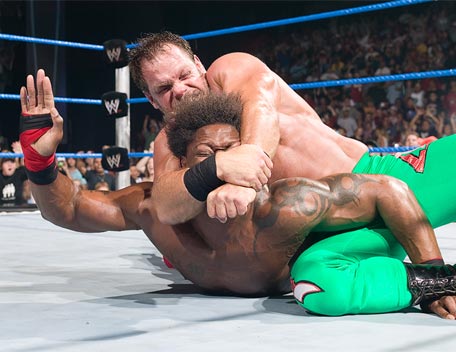
Submission Hold

Chris Benoit's Crippler Crossface Submission Hold
Michele Bachmann appeared on "Face the Nation" to offer her interpretation of the word
'submission.' According to her, "submission means respect, mutual respect."

I have to applaud Bachmann's commitment to personal freedom here. She is so anti-establishment, she will redefine the meaning of words.

No one is going to tell Michele Bachmann how to interpret the sounds coming out of her mouth.

When Michele Bachmann says something, she expects people - even the mainstream media -  to understand her intended meaning, regardless of what the dictionary or common sense might dictate.

So, when you hear Bachmann's 2006 statement, "Wives, you are to be submissive to your husbands," you should know that she actually means, 'Wives, you should be in a mutually respectful relationship with your husbands.' And she won't back down from the bland message she's sending in that bold misinterpretation.

You would be mistaken, therefore, to apply the commonly accepted definition of 'submissive' to her statement - "Wives, you are to conform to the authority or will of your husbands,"
OR
"Wives, you are to be meekly obedient or passive to your husbands."

If you made that mistake, you would be submissive to the authority of language and its social construct, and --- wait... And in this instance, the word 'submissive' is, ah... Here the word does not mean 'mutual respect'. Here 'submissive' is used in to suggest meek obedience... Which is bad. Submission in this case is bad, okay...?

Boy, if we're going to use Bachmann's definition, we're going to need a new word to take the place of what submissive used to mean.

Any suggestions?

Saturday, July 30, 2011

Are We Retreating from Science?

The developing story about the suspension and investigation of arctic scientist Dr. Charles Monnett leaves me asking questions about science's role in the public discourse.

My composition students and I spend a lot of time examining how various types of evidence are valued in different communities. For example, policy makers appreciate statistics that are easy to interpret. The media gravitates toward gripping visual images. Literary scholars like well-articulated analysis that emphasizes context. Experimental scientists look for reproducible results.

In all of these communities, participants need to simultaneously communicate what it is they value as evidence while presenting their ideas using the evidence others value.

It isn't easy, but it becomes especially difficult when you throw politics, authority, and money into the mix.

A science news story is developing (see also here & here) that might shed light on the types of evidence we value - or fail to value - in the public discourse.

The Players
Dr. Charles Monnett: an arctic scientist working for U.S. Bureau of Ocean Energy Management Regulation and Enforcement (BOEMRE). Monnett has published findings about arctic wildlife that suggest a need for greater caution as we search for energy in arctic waters. 
 
The director of BOEMRE Michael Bromwich: a public servant supervising a U.S. agency that, among other things, leases the offshore exploration rights to private energy companies. 

PEER, a special interest group that defends public workers who protect the environment. The group has lodged a complaint over Monnett's suspension. 

Those who assert climate change is "junk science." These people believe that Monnett's work is not rigorous, and claim he has an agenda that informs his research. 
(I have not found these claims to be persuasive, but the influence of such claims can be felt while investigating this issue.)

The Context
Monnett's most publicly known work is about drowned polar bears he observed in 2004. The data from his paper was featured in Al Gore's slideshow/movie, An Inconvenient Truth

The original paper was written by Monnett and Jeffrey S. Gleason. It was published in a 2006 issue of Polar Biology - a peer review journal. A community of scientists reviewed the work and decided it was a valuable contribution to endeavors in the field of arctic biology. 

While at least one climate change skeptic has labeled Monnett's work as "junk science," it seems as though the blogger hasn't read Monnett and Gleason's paper, as the post never mentions Gleason.

The Story 
Monnett is under investigation for unspecified allegations and has been suspended from doing his work for the Department of the Interior.


There is room for a massive conflict of interest on BOEMRE's part in this scenario - much of the funding for the department comes from leases for energy exploration.  

Bromwich has not announced why Monnett is being investigated and justifies this with his quote, "We are limited in what we can say about a pending investigation."

The Question
I believe this is a case of our government retreating from scientific evidence, and I think the situation poses the following question: Do we as the American public value the input of scientists when the interests of the environment and energy conflict?

The Details
This gets a bit long.
On the 28th of this month, a press release was published protesting the investigation and suspension of a leading Arctic scientist, Dr. Charles Monnett - who supervises a large amount of research for the BOEMRE.

The press release and a formal complaint were both composed by the Public Employees for Environmental Responsibility (PEER). PEER has suggested that Dr. Monnett's suspension is motivated by political or profit driven ambitions. The press release actually goes so far as to call the investigation a "witch hunt" (although, I don't think PEER does itself any favors with that choice of words). 


According to the official complaint, Monnett "has been placed on administrative leave and suspended from his [...] duties due to 'an on-going inquiry'[...] yet Dr. Monnett has not been informed of any specific charge or question relating to the scientific integrity of his work."


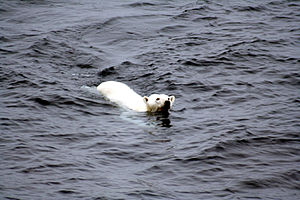
Both PEER and the media outlets reporting this story have linked the suspension and investigation to Monnett and Gleason's 2006 paper published in Polar Biology. Monnett and Gleason's paper describes the bodies of 4 dead polar bears seen floating in the waters off the coast of Alaska - an undisputedly unusual sight. The paper suggests that the drownings can be attributed to late-ice/mild ice years and suggests that the the number of polar bear deaths is likely to increase as global temperatures rise. 


The paper and accompanying images gained notoriety when they were used in Al Gore's slideshow/movie, An Inconvenient Truth


In a story today, the connection between the 2006 paper and the current investigation was denied by the director of BOEMRE, Michael Bromwich. He stated in an email that the suspension  "had nothing to do with [Monnett's] scientific work" and "was the result of new information on a separate subject brought to our attention very recently." That's all he says about the allegations in the email.

PEER, however, has provided journalists with documentation that suggests the investigation is related to Monnett's work on polar bears. Today's story reports that a July 13th stop-work order was issued for a polar bear tracking study. The letter Monnett received from his contracting officer at the time of that order states there is doubt about Monnett's ability to judge data in "an impartial and objective manner on the subject contract." This conflicts with Bromwich's statement.

Also, Bromwich's claim that the information came to his "attention very recently" is a bit odd. One record of an BOEMRE official working on this investigation is from February of this year. Maybe by "state-work standards" that is very recently, but the allegation's merit is less than convincing. According to transcripts of a meeting between Monnett, a representative from PEER, and two BOEMRE investigators, when pressed for specific allegations, the BOEMRE response was, "well, scientific misconduct, basically, uh, wrong numbers, uh, miscalculations" (Line 12, Page 83).

And of course, there is the climate change skeptic's blog with a post on this story. The author linked the investigation to Monnett's work with polar bears - contradicting the director's statement. (And as a side note, the blogger cherry-picked a passage from the transcript to suit her purposes. The transcript is actually kind of funny- the investigators questioning Monnett don't know much about research protocols or publishing conventions.)

The motivation of the investigation is not yet clear - not to the public, nor even to the man being investigated. Nevertheless, a leading scientist has been barred from doing his work.

The Implications 
Now, this story may develop. Maybe there is something I'm missing. I'll allow that.

The story, however, is a few days old. An employee advocacy group has objected, and the media has picked this up. The allegations should have been made public by now.  

Dr. Monnett has been tracking arctic wildlife for years, and some of his scholarly work has made the very difficult journey into the public consciousness. He appears to be a valuable contributor to the Department of the Interior's mission of "protecting America's great outdoors and powering our future."

Until we are informed otherwise, there is no reason to believe Dr. Charles Monnett did something that should keep him from his work, unless...

...Unless paying attention to Monnett's work on polar wildlife might influence what some believe to be a more important public good - energy production.

Was Dr. Monnett's decision to submit his findings for publication a step too far? Does his work hinder the public discourse? 

Of course not. His work helps us construct a clearer picture of the risks and opportunities involved in energy exploration. We should welcome his voice and critique it in an open forum. It appears at least for now, however, people with authority are punishing him for enriching the debate.

As this story develops we need to ask ourselves: Do we as the American public value the input of scientists when the interests of the environment and energy conflict?

I hope so.

Wednesday, July 20, 2011

An Abuse of the Word 'Research'

Chris Haworth, a friend of mine, posted a link to a study recently published by the Heritage Foundation.
The study was conducted by Robert Rector and Rachel Sheffield. It is an excellent example of the methods people use to corrupt the public discourse.

While I think the Heritage Foundation is an important voice, this particular study was conducted poorly. The study seeks to misinform. It is polemical and, in my judgment, unethical.

The study is labeled as a "Backgrounder on Poverty and Inequality." Its findings are primarily this: Most of the people who the US Census Bureau has labeled as individuals living "in poverty" should not be described as poor. This conclusion is based on 2005 survey data about the household appliances in homes of people who the Census Bureau categorizes as living below the poverty threshold.

The study is motivated by the fact that "in discussions about poverty... misunderstanding and exaggeration are commonplace." The researchers believe that "exaggeration has the potential to promote a substantial misallocation of limited resources for a government that is facing massive future deficits." They are concerned that Americans may have the wrong impression about the living conditions for a family of 4 earning less than $20,615/year.

The study's data show that in 2005, most families living in poverty have food security and a home. On top of that, most families living in poverty may have air conditioning, cable, or an Xbox (some may have all three). From this, the researchers conclude that in many cases, it is incorrect to describe a family of 4 earning less than $20,615/year as "poor."

I think the motivation for this study is interesting, and it deserves investigation. The way we label large portions of our population has huge potential impacts. Any investigation conducted, however, should seek as honest a depiction as possible.

Rector and Sheffield used data from 2005, despite the existence of a 2009 survey (they claim the microdata they need is not yet available). 2005 was at least two years before the economic crisis hit. At the time, credit was cheap and predatory lending was commonplace. In 2005, banks regularly were extending loans to people who couldn't afford to buy a home. 2005 was was a year when people thought they had money because they were living in an economic bubble. It is the wrong year from which to elicit data for this kind of study.

The study's conclusion quotes officials who the researchers believe are misinforming the  public about being poor in America. The researchers claim that Children’s Defense Fund President Marian Wright Edelman has it wrong when she says, “It is a moral outrage that in the wealthiest nation on earth there are still 12.8 million children living in poverty” and “inexcusable that 12.8 million children are forced to suffer through hardship every day.” Rector and Sheffield claim that it is an exageration to suggest that children living in poverty suffer hardship.

Here's the math:
A family of four earns $20,615 to spend per year.
That's $1,718 per month.
That's $429 per person per month.
That's $107 per person per week.

If a person plans to accumulate no savings, they have nearly $110 a week for housing, utilities, food, clothing, education costs, and transportation. To assume that such a budget does not create hardship because in 2005 most poor families had cable is an abuse of the research process. It is an attempt to misinform the public using the guise of reputable research.

This is why critical thinking skills are so crucial if we expect today's students to engage in the public discourse. The study looks and reads like reliable material, but it is empty rhetoric aimed at undermining efforts to address economic inequality in America.

Saturday, July 09, 2011

Why Does a Failed Plan Live On?


There is something in the current budget negotiations that I don't understand: Why are we still listening to the "no new taxes" argument?


The people who are opposed to any/all new taxes are suggesting the nation's wealthiest create jobs, but they have no proof of that.

They want the public to ignore recent history: The 2003 Bush tax cuts were extended in late 2010. We are still facing a debt/deficit crisis, and the jobs numbers have not improved significantly.

The top earners in the US have enjoyed 8 years of Republican-approved tax breaks. The argument supporting those breaks is that top earners create jobs, but the jobs numbers are horrible. The promised job have not been created. The economy has not recovered. The debt crisis has grown.

The President yielded, and the Republican Congress passed the tax cuts they wanted last December. There has been no sign that those cuts have helped our economy. The Republican tax plan failed... again.

Why is anyone still listening to them? Their tax policy is a one trick pony, and the trick doesn't work.


I understand that these politicians won a midterm election, but they got what they wanted and it failed. Their 'no compromise' attitude is looking like willful ignorance at this point. They are not leaders worth following anymore.

Sunday, June 12, 2011

Audience and Africa

Hillary Clinton has taken a rather candid shot across China's bow. While on a diplomatic tour of Africa, she described China's newish influence on the Continent as New Colonialism.

She's suggesting China's representatives are going into Africa for the natural resources, paying leaders for access, and getting what they paid for. Which sounds fine if you think of Africa like a Stop-n-Go.  If, however, you take Africa's history with these kinds of transactions into account, Clinton's comment cuts pretty deep, from a Western point of view, at least.

I think Clinton has a point, and I like that someone has the... guts to call this as she sees it. In several of these exchanges, China is dealing with notoriously corrupt leaders to gain access to local resources. Often the result is rich African leaders with more money to defend themselves from the civil unrest fomented by dwindling resources and stagnant development. It's bad news. This NPR story has a nice bit on how African leaders are happy that China doesn't attach strings to its investments. No one talks about human rights during these exchanges, they talk about coal and currency.

It seems like Clinton's message should be loud an clear for all involved. But there's a rhetorical problem here. It's one of audience and frame of reference.

Let's start with the US:
When US officials speak publicly on diplomatic issues, they believe they are actually speaking publicly - that they are speaking to the citizens of a nation. There are plenty of private talks with leaders, of course, but in these open forum talks - like the ones in which Clinton is chastising China - US figures believe they are speaking "for the world to hear."

Part of this belief is influenced by the US conviction that the power of a nation is held in the hands of its citizenry.

China, on the other hand...
China has a government and culture that believes centralized power and respect for authority are the natural way of things. When the Chinese make deals with African leaders (corrupt or not) they believe they are meeting all of the appropriate expectations for international exchange. The Chinese don't see the well-being of African citizens as a Chinese concern. The African leaders are the ones who have to worry about the well-being of African citizens, and the Chinese are giving those leaders lots of money.
The Chinese beleive that the power of a nation is held in the hands of its leaders.

Then there's Africa.
We might see a shift in the near future, but for now, and for most of modern history, many African citizens have not been able to shake autocratic rule. The history is brutal in many places, and hope for an empowered citizenry has been fleeting-at-best in many nations. There are exceptions, but those are not the places that Clinton's concerns are focused.
The African leaders that enjoy the benefits of autocratic regimes are happy to have trade partner that won't challenge the status quo, and the citizens are not yet in a place to effectively voice any kind of opposition... yet. They don't see themselves as agents of change in today's Africa.

I like to think the only legitimate source of power for governments comes from the people being governed, but some of the actors in this US-China-Africa exchange do not share my views. That's bound to affect how messages are composed, transmitted, and received.
Clinton speaks to the concerns of global citizens.
China speaks to the concerns of leaders of nations.
Both believe they have the ear of the people with legitimate influence. Both have good reason to believe they've picked the right audience.
African leaders like being the primary audience, and they have very real influence.
Citizens of African nations should have a say in where their nations' resources go, but the impact of those citizens is hard to measure.

Just another wrinkle in geopolitical diplomacy, I suppose, but also a nice way of considering the "Speaker-Audience" relationship.